
Please note: this is a practice case study. Sample Finance App is a fictional UK lender, and every product term, credit score, threshold and rate is illustrative, not real lending criteria. All applicant data is synthetic. The regulatory points are my summary as a business analyst for framing requirements, not legal or compliance advice.
Small loans from a community lender can keep someone away from much more expensive credit. But if the application takes a week and needs a posted form, many people give up and borrow somewhere worse. This post walks through how I would move a community lender’s small-loan applications online, from the first process maps to what the customer would see on an iPhone.
The full pack is on GitHub: microfinance-loan-application. It has the project brief, process models in Mermaid and BPMN 2.0, decision tables, API requirements, a repayment schedule, user stories and a traceability matrix, plus a small Python rule engine that tests every worked example.
The problem
Sample Finance App lends £200 to £2,000 to people who find it hard to borrow from high-street banks, such as people with thin credit files or irregular income. Today, customers apply by phone or on paper. A loan officer keys in the details, runs a credit check in TransUnion’s portal, works out affordability on a spreadsheet and posts out the agreement.
| Measure | Today (illustrative) |
|---|---|
| Applications a month | about 900 |
| Time from application to decision | 3 to 5 working days |
| Applications abandoned before a decision | about 30% |
| Loan officer time per application | about 45 minutes |
| Spreadsheet affordability errors | about 1 in 20 |
Mapping the as-is process showed five pain points: details keyed by hand, affordability worked out on a spreadsheet, decisions that depend on which officer you get, decline letters with no clear reasons, and a paper agreement that adds two or three days. I wrote the problem statement around those: a slow, manual process makes applicants give up and turn to higher-cost lenders, gives inconsistent decisions and costs too much per loan.
The targets for six months after go-live were 70% of applications decided within 10 minutes, drop-outs down to 15% or less, and 100% of audited decisions following the documented rules.
The process, end to end
The to-be process has six stages: create an account and verify identity, check eligibility, complete the full application, get an automated decision, sign and receive the money, then repay monthly by Direct Debit. I modelled it twice. Mermaid diagrams render straight on GitHub and are quick to change in a workshop. The formal BPMN 2.0 model has lanes for the applicant, the loan platform, the rule engine and the underwriter, with TransUnion, the open banking provider and the payments provider as separate pools.

Three design decisions came out of the process mapping:
- Soft search first, hard search only when the applicant chooses to continue. Other lenders can see a hard search on a credit file. Someone who is unlikely to be accepted shouldn’t collect one for nothing.
- A document-and-selfie route when the electronic identity check fails. People with thin credit files are exactly who this lender exists to serve, and they’re the ones most likely to fail an electronic check.
- A system failure pauses an application; it never decides it. If TransUnion or the bank connection times out, the applicant is told when they’ll hear back. Nobody is declined because of a timeout.
How the decision is made
The rule engine works through four stages in a fixed order and stops at the first decline. I wrote the rules as decision tables rather than burying them in code, so the credit risk and compliance teams can read, question and change them, and any past decision can be replayed against the rules version that made it.

| Stage | What it checks | If it fails |
|---|---|---|
| 1. Knock-outs | Age, UK residence, identity, active bankruptcy, IVA or Debt Relief Order | Decline, with every reason listed |
| 2. Risk band | Credit score, missed payments, defaults | Band E is declined |
| 3. Affordability | Monthly payment against disposable income | Counter-offer at a lower amount, or decline |
| 4. Referral triggers | Band D, declared income well above bank data, a recent County Court Judgment, a thin credit file | Refer to an underwriter |
Affordability takes a cautious reading on purpose: the lower of declared income and income seen in 90 days of bank data, and the higher of declared spending and a standard estimate for that household size. The monthly payment must be no more than 40% of what’s left, and at least £150 must remain after paying it. If the amount asked for fails, the engine steps down in £50 steps to find the highest amount that passes.
Nine synthetic applicants test the rules. Two show why the reasons matter:
- S3 has a good credit history but only £270 a month to spare. £1,500 over six months would cost £272.25 a month, so the engine offers £550 at £99.83 a month instead, which leaves £170.
- S7 has an excellent credit score but only £200 a month to spare. Even the smallest loan would leave less than the £150 buffer, so it’s a decline on affordability. The reason says so, because telling someone with a strong credit file that their credit history was the problem would be wrong and unhelpful.
Every worked example in the documents is also an automated test in Python (20 tests), so the written rules and the prototype engine can’t drift apart.
What it looks like on an iPhone
The brief puts the web journey first and a mobile app in phase 2. To show how the phase 2 app could work, I designed nine iPhone screens. Each one shows a business rule or a regulatory point, not just a layout. All figures on the screens come from the rule engine and the repayment calculator.
Applying
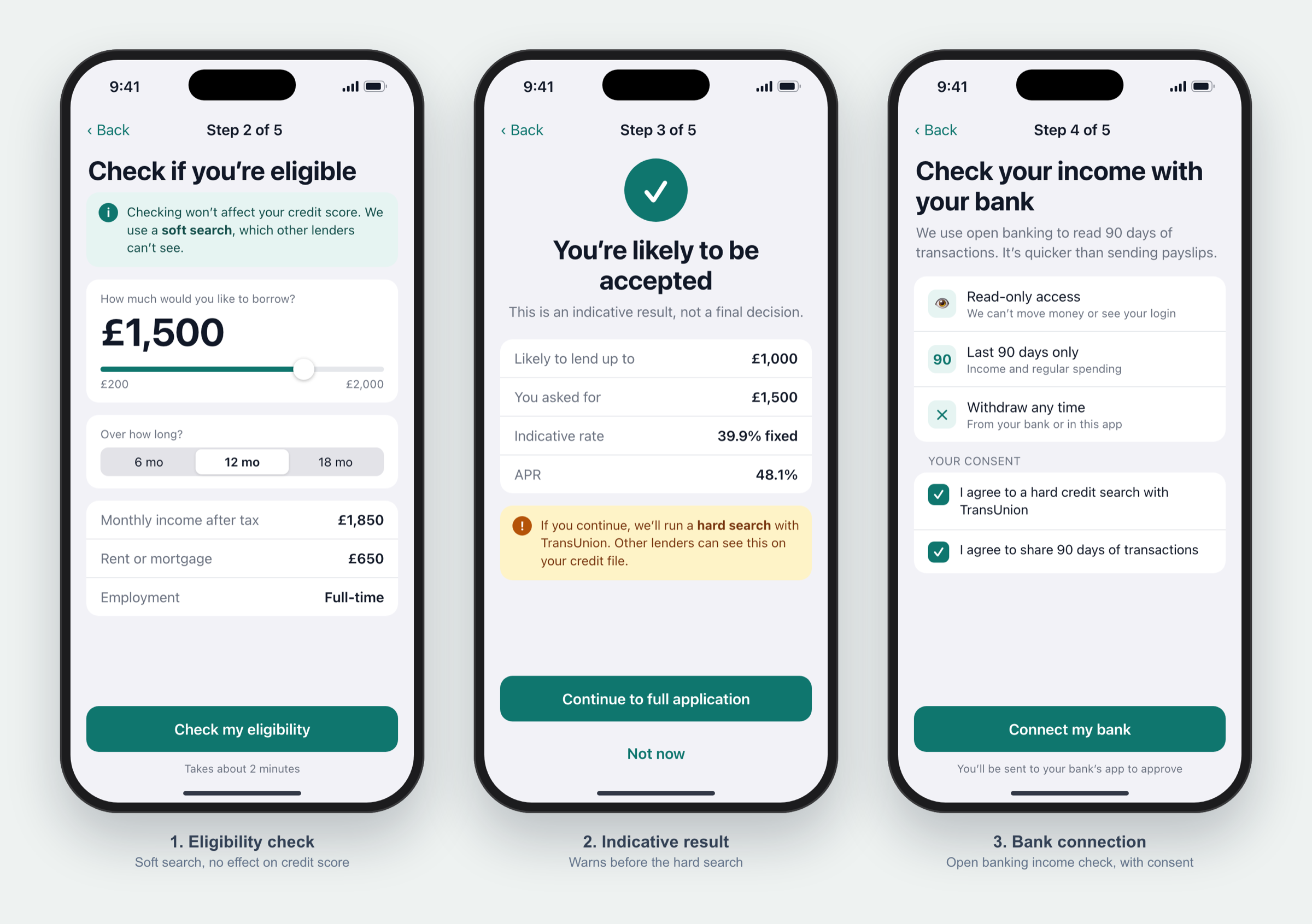
- Eligibility check. The screen says in plain words that checking won’t affect the applicant’s credit score. This is acceptance criterion AC2 of user story US-04.
- Indicative result. It’s labelled as not a final decision, and it warns before the hard search runs.
- Bank connection. Open banking reads 90 days of transactions to check income. The screen explains what the lender can and can’t see, and asks for consent to the hard search and the data sharing separately.
The decision
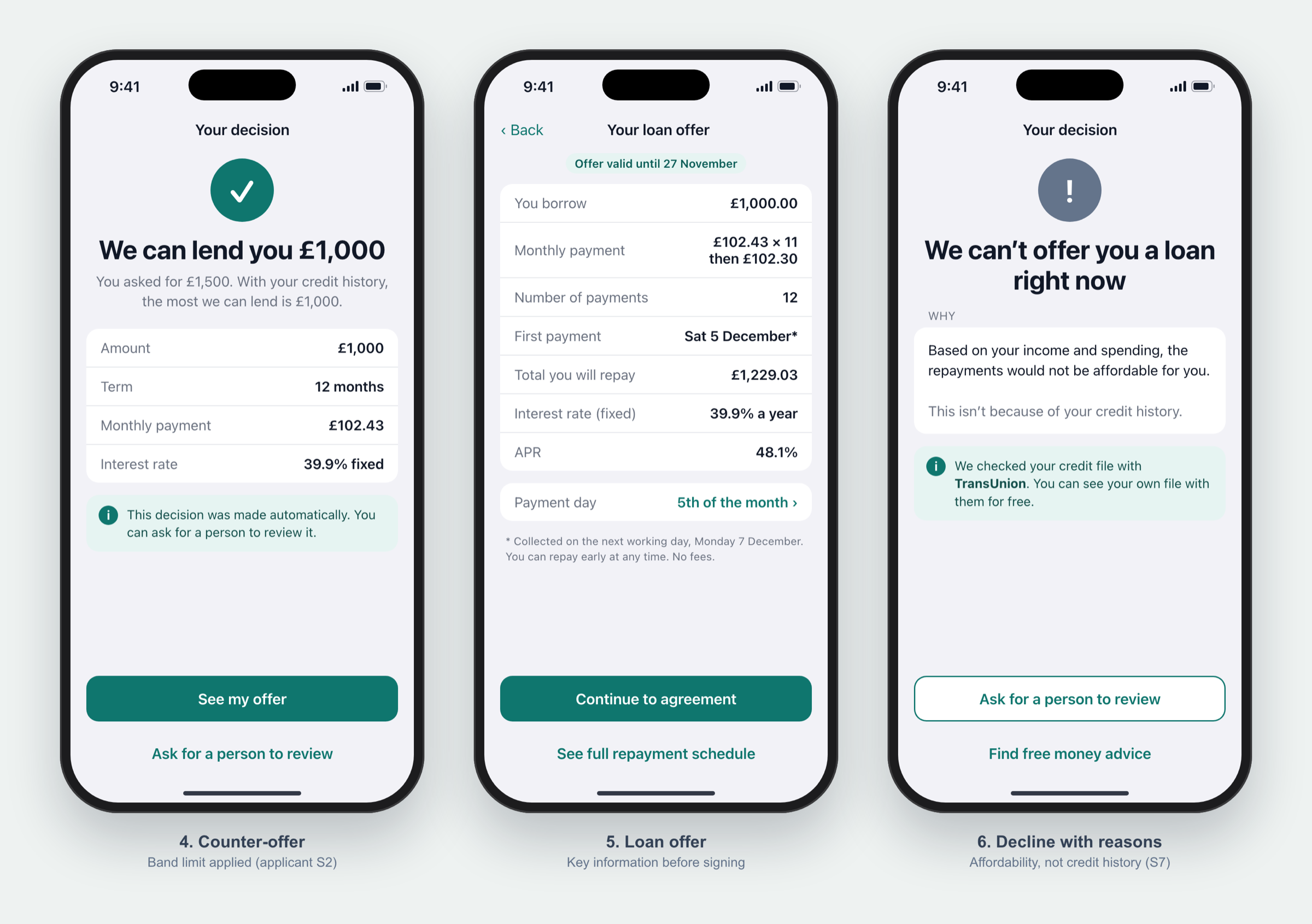
- Counter-offer. Applicant S2 asked for £1,500 but sits in risk band C, where the most the lender offers is £1,000. The screen says why the amount is lower, as US-09 requires. It also offers a human review, because under UK GDPR Article 22 people can ask for a person to look at a fully automated decision.
- Loan offer. The key information comes in the order a customer reads it: amount, monthly payment, number of payments, first payment date, total to repay, interest rate and APR.
- Decline with reasons. The main reason is in plain English, the screen names TransUnion as the credit reference agency used, and it links to a human review and free money advice.
Repaying
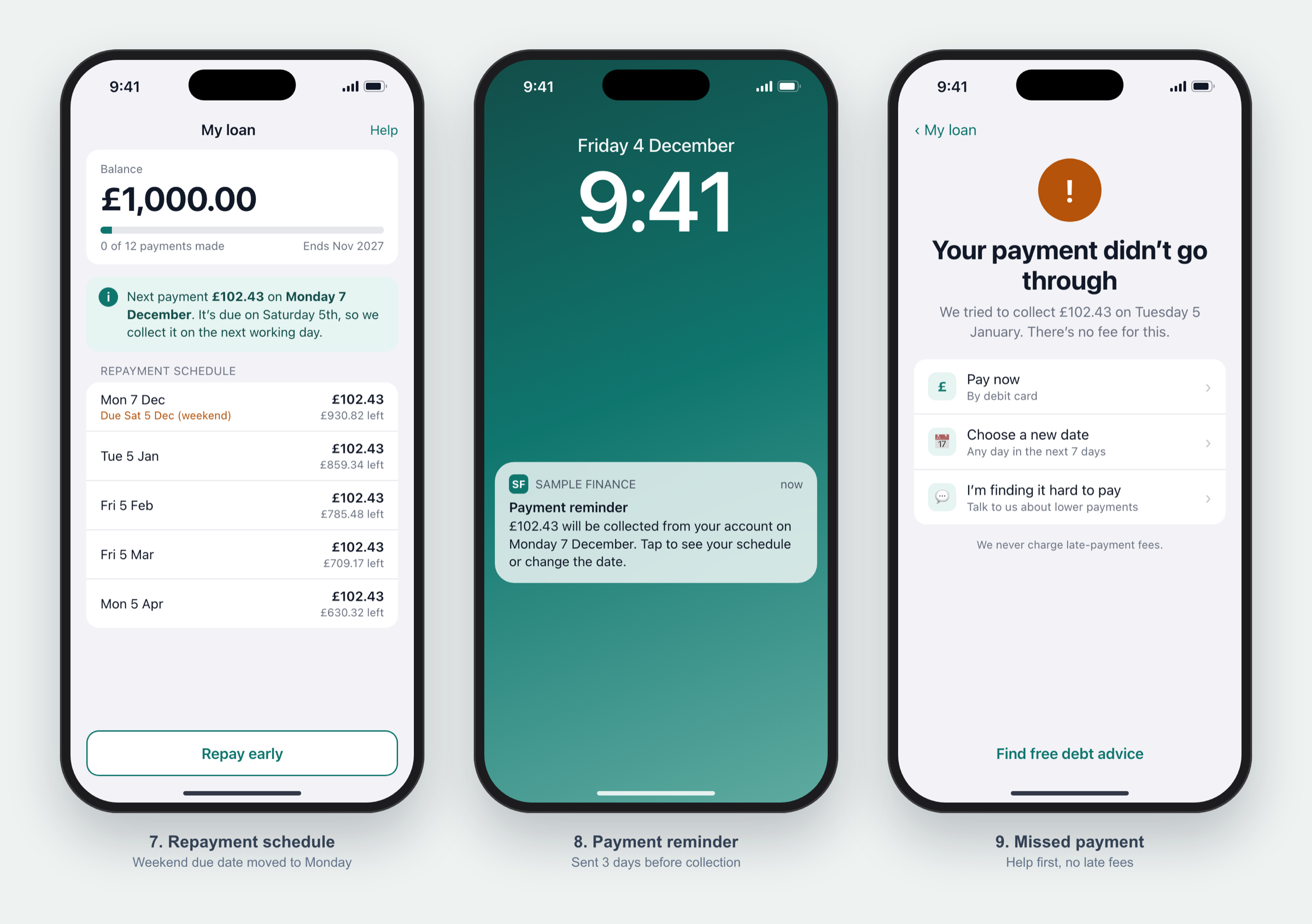
- Repayment schedule. The first payment falls on Saturday 5 December, so the schedule shows that it’s collected on Monday 7 December.
- Payment reminder. It’s sent three days before each collection, with the amount and the date.
- Missed payment. There are no late fees in this design. The screen offers ways to pay, a new date within seven days, or a conversation about lower payments.
The offer screen follows the text mock-up in the repayment document. One small detail matters here: the last payment is 13p lower than the others, because each instalment is rounded up to the penny. So the screen shows “£102.43 × 11, then £102.30” rather than a single figure that would be wrong for one payment.
The repayment rules
The repayment rules are short, but each one needed a decision from the business:
| Rule | Decision |
|---|---|
| Interest | Fixed annual rate by risk band, charged monthly on the outstanding balance |
| Instalments | Equal monthly payments rounded up to the penny; the final one adjusted to clear the balance exactly |
| Payment day | Customer chooses the 1st to the 28th, so every month has the date |
| First payment | The chosen day in the first month at least 14 days after payout |
| Weekends and bank holidays | Collected on the next working day, with no extra interest |
| Fees | None, including for missed payments or early repayment |
For the worked example of £1,000 over 12 months at 39.9%, that gives £102.43 a month, £1,229.03 in total and an APR of 48.1%.
From design to delivery
The pack has 16 user stories across seven epics, each with Given/When/Then acceptance criteria. For example, US-08 (get a decision in minutes) includes: given any data is missing because an integration failed, then the application is paused, not declined, and the applicant is told when they’ll hear back.
A requirements traceability matrix links every story to its process step, the rules it uses, the regulation behind it, the objective it serves and the tests that prove it. Stories covered by the automated tests point to them by name, and the rest are marked for user acceptance testing.
What I’d ask the business next
A BA pack like this ends with questions, not answers. These are the ones I’d take to the stakeholders first:
- Are the score thresholds right for this lender’s customers? They should be back-tested on two years of decisions and repayment outcomes.
- If underwriters are short of time, should band D be declined automatically instead of referred?
- Are a 40% share of disposable income and a £150 buffer the right level of caution?
- How will decisions be monitored for fair outcomes across groups of customers under the Consumer Duty?
Further reading
- The full pack on GitHub: microfinance-loan-application
- A similar requirements pack for a retailer: Online returns requirements
- Automated decisions and a DPIA in practice: GenAI repairs triage
- Interview practice: Write a user story for a login feature, What’s an API, and how would you test one? and How do you support UAT?