
Practice case study. Fernbridge Home is a fictional retailer and every figure is illustrative. I built this case to show how I run a requirements piece end to end. It is not client work.
- Client
- Fernbridge Home (fictional), 40 stores plus website
- Sector
- Retail
- My role
- Business Analyst, end to end
- Delivery approach
- Requirements baselined up front, built and tested in sprints
- Methods
- Stakeholder analysis, RACI, process mapping, root cause analysis, MoSCoW, user stories, RTM, UAT
- Executive summary
- The problem and the objectives
- Approach
- Stakeholders: who could stop this?
- As-is analysis: where the 12 days go
- To-be design
- Requirements: BRD, user stories and traceability
- Testing: UAT plan
- Expected impact and next steps
Executive summary
Fernbridge Home sells homeware through 40 stores and a website. Online sales have grown to about 35% of revenue, and online returns to around 1,800 a month.
Returns still run on email, phone calls and a shared spreadsheet. Refunds take an average of 12 days, about 33% of customer service calls are customers chasing a return, stores turn away online returns and nobody can say how much returned stock is waiting in the warehouse.
What does the business need from a new returns process, and how will we know it works?
One return record in the order management system (OMS), status driven by events (label scans, inspection results) rather than emails, and more ways to send items back. That brings the refund time down to about 5 days. I wrote this up as a baselined BRD, 15 user stories with 45 acceptance criteria, a full RTM and a UAT plan.
1. The problem and the objectives
The returns process was designed when online sales were small. A customer has to email or phone to start a return, customer services log it in a spreadsheet, the warehouse updates that spreadsheet once a day and finance keys each refund by hand. I framed the problem with the sponsor (Director of Customer Operations) as a single problem statement, then agreed four measurable objectives before talking about solutions.
Problem statement
The problem of a manual, email-based returns process affects online customers, customer services, the returns warehouse and finance, and results in slow refunds, high call volumes and poor visibility of returned stock. A good solution would let customers start and track a return themselves, and pass each return between teams automatically.
| ID | Objective | Baseline | Target (6 months after go-live) |
|---|---|---|---|
| OBJ-01 | Refund customers faster | 12 days average | 5 days or fewer |
| OBJ-02 | Reduce avoidable contact | 33% of calls about returns | 15% or less |
| OBJ-03 | Accept online returns in store | 0 of 40 stores | 40 of 40 stores |
| OBJ-04 | Know where every returned item is | Spreadsheet only | 100% tracked in the OMS |
Scope was agreed early to stop scope creep later: parcel-delivered online orders, self-service returns, prepaid labels, store returns, tracking and automatic refunds are in. Large furniture, exchanges, marketplace orders and changes to the 30-day policy are out, and exchanges are logged as phase 2.
2. Approach
I followed the standard requirements life cycle, with each document built from a template in my BA toolkit so the pack stays consistent.
- 01
Frame
Problem statement, objectives, scope, assumptions and early risks agreed with the sponsor.
- 02
Engage
Stakeholder register, power/interest map and a RACI so every decision has exactly one Accountable.
- 03
Map the as-is
Walk the current process with the people who run it, time each stage and log pain points with evidence.
- 04
Design the to-be
Design principles from the root causes, then the future process and a change summary.
- 05
Specify
BRD with MoSCoW priorities, then epics and user stories with Given/When/Then acceptance criteria.
- 06
3. Stakeholders: who could stop this?
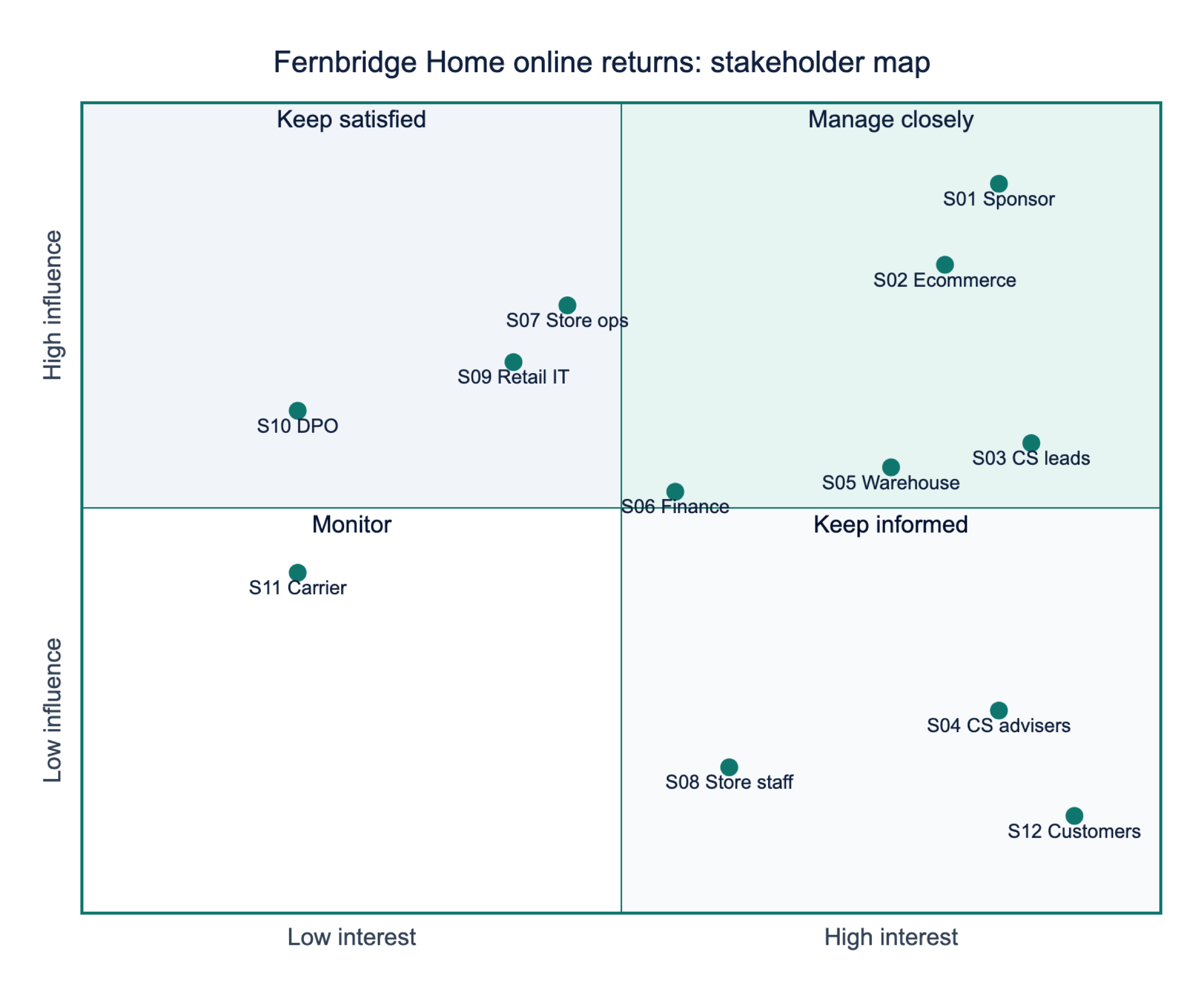
I listed 12 stakeholder groups and placed each on a power/interest grid. Three findings shaped the plan:
- Store operations is the biggest risk. High influence and currently resistant, because in-store returns add work at the till. A two-store pilot and clear stock-handling rules come before any wider rollout.
- The Data Protection Officer can stop go-live despite low day-to-day interest. Showing order details at the till needs DPIA screening early, not the week before launch.
- Customers had not been asked. A short survey of recent returners tests the assumption that they want to track returns online.
A RACI then fixed decision rights: the product owner is accountable for the BRD and the backlog, finance for refund rules, the DPO for the DPIA, and the sponsor for the go-live decision.
4. As-is analysis: where the 12 days go
I mapped the as-is process as BPMN-style swimlanes (customer, customer services, warehouse, finance, store) and timed each stage against a sample of 200 returns.

| Stage | Average elapsed time |
|---|---|
| Request received → returns form sent | 1.5 days |
| Form sent → parcel arrives at warehouse | 4 days |
| Parcel arrives → inspected and spreadsheet updated | 3 days |
| Spreadsheet updated → refund requested from finance | 1.5 days |
| Refund requested → refund issued | 2 days |
| Total | 12 days |
The key insight
Two-thirds of the delay (8 of 12 days) is internal handling and waiting between teams. Only the 4 days in the post are outside Fernbridge's control. A faster courier would not fix this; fixing the hand-offs would.
The eight pain points traced back to three root causes:
- No single record of a return. It lives in emails and a spreadsheet, so every team has to ask another team for its status (P2, P3, P6).
- Hand-offs by email. Each team passes work on by email or in daily batches, adding waiting time at every step (P1, P4, P6, P7).
- A process built around posting, not the customer. No label, no tracking and no store option (P1, P5, P8).
5. To-be design
For the to-be process, each root cause became a design principle: one record per return in the OMS; events, not emails, so status changes when a label is scanned or an item is inspected; more ways to send it back (prepaid QR label or any store); and people handle exceptions only, such as refunds over £250 or eligibility reviews.

| Stage | As-is (days) | To-be (days) | Why |
|---|---|---|---|
| Request → label sent | 1.5 | 0 | Self-service; label issued straight away |
| In transit to warehouse | 4 | 3–4 | Unchanged (carrier); store returns refunded at the till |
| Arrival → inspection recorded | 3 | 1 | QR scan on arrival; inspection next day |
| Inspection → refund issued | 3.5 | under 1 | Automatic refund; finance approves exceptions only |
| Total (posted returns) | 12 | about 5 | Meets OBJ-01 |
The 1-day inspection assumes current warehouse staffing can keep up. That is flagged for testing with the warehouse manager.
6. Requirements: BRD, user stories and traceability
The BRD sets out 15 business requirements, each traced to a pain point or workshop and to an objective, plus 6 non-functional requirements covering availability, till performance (look-up within 3 seconds), data minimisation at the till, WCAG 2.2 AA, a 7-year audit trail and the 14-day legal refund limit.
| Priority (MoSCoW) | Count | Examples |
|---|---|---|
| Must | 11 | Start a return online, automatic eligibility check, QR label or store, single return record, automatic refund |
| Should | 3 | Return reason capture, email/text notifications, returns report |
| Could | 0 | – |
| Won't (this phase) | 1 | Exchanges, deferred to phase 2 |
I broke the requirements into 6 epics and 15 user stories with 45 acceptance criteria in Given/When/Then form, so every story is testable. For example:
US-01 Start a return online (Must)
As a customer with a delivered online order I want to start a return from my account or with my order number and email so that I don't have to call or email customer services.
- Given I enter an order number and email that don't match, when I submit, then I see “We can't find that order” and no order details are shown.
- Given I select items and confirm, when the return is created, then I see a return number and the return is saved with status Requested.
The RTM links every requirement from its source (pain point or workshop) to its objective, user stories and UAT test cases. At baseline, no Must or Should requirement is left without a story or a test.
7. Testing: UAT plan
UAT is planned from the acceptance criteria: 18 test cases with full scripts for the 6 highest-risk ones (for example, a refund sent after approval, and a store refund to the original card). Testers are the people who will use the process: customer service advisers, store colleagues from the pilot stores, a warehouse operative and a finance analyst. Defects are tracked in Jira against the user stories.
| Exit criterion | Target |
|---|---|
| Must test cases run / passed | 100% run, 95% or more passed |
| Open Critical or High defects | None |
| Medium and Low defects | Logged with fix dates or agreed workarounds |
| Sign-off | Product owner, finance and store operations |
8. Expected impact and next steps
- Refund time falls from 12 days to about 5, meeting OBJ-01 and staying well inside the 14-day legal limit.
- Avoidable calls should fall towards the 15% target, because customers can see status online and get updates.
- Stores can accept online returns, starting with a two-store pilot before peak.
- Operations gets a returns report: volumes, reasons, cycle time by stage and the inspection backlog.
Three open questions go to the right owners before build: refunding low-value returns at drop-off (finance), store refunds when the customer doesn't have their card (finance and retail IT), and who pays for the return label (sponsor).
What I'd do next on a real project
- Validate the timings against live data rather than a sample before the business case is signed.
- Run the customer survey early: it could change the priority of tracking and notifications.
- Pair the store pilot with a short time-and-motion study at the till, since store operations is the main adoption risk.
Methods, deliverables and further reading
Every method and tool in this case study links to its page in my BA toolkit or glossary. Here they are in one place:
- Business Requirements Document
- User story
- Acceptance criteria
- Requirements traceability matrix
- User acceptance testing (UAT)
- Problem statement
- Scope creep
- Stakeholder analysis
- Power/interest grid
- RACI
- Pain point
- Root cause analysis
- MoSCoW prioritisation
- Epic
- Stakeholder
- Pilot
- Data Protection Impact Assessment
- Product owner
- Backlog
- As-is (current state)
- BPMN
- To-be (future state)
- Workshop
- Non-functional requirement
- Jira
- Sign-off
- Business case
Deliverables on GitHub
Interview questions this case answers
- How do you gather requirements?
- What is the requirements life cycle?
- What's the difference between a BRD and an FRD?
- Functional versus non-functional requirements?
- How do you prioritise requirements?
- Write a user story for a login feature.
- How do you support UAT?
- How do you deal with a stakeholder who won't engage?
More case studies
Public data analysis · Healthcare
NHS A&E Waiting Times: Where Does the Pressure Build Up?
SQL and Python analysis of 30 months of NHS England A&E data, a live dashboard and five recommendations on where to focus improvement.
Read case study →Practice case study · Social housing
Generative AI Adoption: Triage of Tenants' Repair Emails
An AI adoption assessment: options appraisal, requirements, UK GDPR and DPIA screening, a pilot plan and a Hugging Face prototype tested on synthetic emails.
Read case study →